Home
Nepal Administrative Staff College

An ISO 9001:2015 Certified Institution

  • Trainings
    • Trainings

      Building capable and future-ready civil servants through practical and impactful learning experiences.

      View all Trainings
      View all Trainings
    • Induction
      • Basic Administration Training (BAT)
    • In Service
      • Professional Course on Management and Development (PCMD)
      • Advanced Course on Management and Development (ACMD)
    • Executive Developement
      • Senior Executive Development Program (SEDP)
      • Secretary Colloquium
      • Management Development for Political Leaders
      • Parliamentarian Conclave
    • Short Courses
      • Assertiveness Skills
      • Customer Service Convenience
      • Fiscal Monetary Coordination Workshop
      • Leadership and Management
      • Learning Organization and Knowledge Management
      • Participatory Planning and Project Proposal Writing (PPPW)
      • Procurement Management
      • Project Management
      • Training of Trainers (ToT)
  • Research
    • Regular Research
    • Journals
    • Report and Publication
    • Internal Research
    • Knowledge Sharing
    • The Training Journal
  • Consulting
    • Management Consulting
    • Research Consulting
    • Training Consulting
  • Portals
    • TMS
    • CDRC
    • OPAC - Online Library

Search

Menu

  • Updates
    • News
    • Proactive Disclosure (RTI)
  • Notices
    • Circulars
    • Procurement of Goods/Works/Services
    • Call for Proposals
    • Auction of Goods
  • Join
    • NASC Vacancy
    • Join as a Trainer
  • Resources
    • Laws and Policies
    • Journal of Management and Development Studies
    • Training Journal
  • Conference
  • About Us
    • About NASC
    • Our Team/Staff
    • Department and Centers
    • Contact Us
  • Suchi Darta
    • Register to Suchi Darta
  • Book a Hall

Social Links

  • facebook
  • linkedin
  • youtube

Menu

  • Trainings
    • Induction
      • Basic Administration Training (BAT)
    • In Service
      • Professional Course on Management and Development (PCMD)
      • Advanced Course on Management and Development (ACMD)
    • Executive Developement
      • Senior Executive Development Program (SEDP)
      • Secretary Colloquium
      • Management Development for Political Leaders
      • Parliamentarian Conclave
    • Short Courses
      • Assertiveness Skills
      • Customer Service Convenience
      • Fiscal Monetary Coordination Workshop
      • Leadership and Management
      • Learning Organization and Knowledge Management
      • Participatory Planning and Project Proposal Writing (PPPW)
      • Procurement Management
      • Project Management
      • Training of Trainers (ToT)
  • Research
    • Regular Research
    • Journals
    • Report and Publication
  • Consulting
    • Management Consulting
    • Research Consulting
    • Training Consulting
  • Portals
    • CDRC
    • OPAC - Online Library
  • Updates
    • News
    • Proactive Disclosure (RTI)
  • Notices
    • Circulars
    • Procurement of Goods/Works/Services
    • Call for Proposals
    • Auction of Goods
  • Join
    • NASC Vacancy
    • Join as a Trainer
  • Resources
    • Laws and Policies
    • Journal of Management and Development Studies
    • Training Journal
  • Conference
  • About Us
    • About NASC
    • Our Team/Staff
    • Department and Centers
    • Contact Us
  • Suchi Darta
    • Register to Suchi Darta
  • Book a Hall

Social Links

  • facebook
  • linkedin
  • youtube

Breadcrumb

  1. Home
  2. Updates
  3. Events
  4. Discourse and Research Conference On Public Policy and Governance In South Asia
Events

Discourse and Research Conference on Public Policy and Governance in South Asia

  • Facebook
  • Linkedin
  • Twitter
  • Email

Published Date

21 Jun, 2017

Event Date

Monday, July 10, 2017 - Tuesday, July 11, 2017

Time

09:00 AM - 03:00 PM

Public policy is framed on the basis of certain theoretical notion to fulfill specific objectives and academic discourse will make this process more peoples centric. The academicians synthesize the issue raised in public policy discourse and generalize it to explain current situation and context so that theoretical base to develop the policy could be framed which will provide basis for independent evaluation of government policies and programs. So, in democratic countries, academic discourse is considered as important component to strengthen institutional capacity of government and its machineries in policy formulation process. The discourse will establish pertinent and acceptable courses of action for dealing with public problems and legitimize the existence of government in the country. As a result, government will be capable of delivering basic services more effectively, maintaining the law and order in the country and achieving country’s overall goal of development and citizen’s welfare.

However, governments of many countries follow hierarchal state structure adopted from autocratic regime so discourse is rarely given enough space[1].. Specifically, entire South Asia[2], was under British Colony until end of World War II which did not give any space to contest against public policy and this orthodox public administrative system is root of almost all South Asian bureaucracies. After British left South Asia in mid 1950’s, there were series political unrests in the region so space for public contestation was hardly provided. In countries like Pakistan and Bangladesh, there were under Military control for more than half period since independence. Emergency was imposed in Sri Lanka even ten years past and India, the largest democracy of the world, had emergency of four years in 1970’s. Nepal was under autocratic monarch and the country had outcast this regime only in 2007. So, state structure of South Asia, has groom in the culture to serve seniors and/or state head with limited space of contestation from others.

However, international bodies like – the World Bank, UNDP and others – started to seriously argue on whether the public policies follow four basic principles of equity, efficiency, security and liberty. Further, South Asia needs to open its space for public contestation as there was major shift from closed economy into liberal market base in 1990’s. The stakeholders of policy started to get expand with political parties and civil servant giving more space to civil society. However, roles of academic and research institution are still dubious because policy makers and academicians still don’t share common platform because policy makers think they are superior in term of experience whereas academician claim to be the knowledge center. Realizing importance of academicians in public policy discourse, many world development bodies have time and again developed the mechanism to fund them for policy researches and develop alliance between the academicians to push agenda forward[3].

In this regard, this academic discourse and conference intends to bring scholars, policy makers and emerging researchers into a forum initiate discussion and sharing experiences on how South Asia should strengthen its institutional capacity in policy making and governance through academic discourse.


[1] Prior to World War II, most of the countries other than those of Europe and North America were either colonized or being ruled by lord king, both of whom were autocratic by nature. In such regime, government mechanism was highly centric toward the head of state and none of state organ can be mobilized without his consent. Likewise, bureaucracy, army and all other states servants were trained to serve the king. However, after World War II, global political platform changes with many of the colonized countries got independence and notion of citizen’s welfare and human right started to discuss. But democratic system did not continue in many of these newly independent countries as either one of their political leader turn out to be autocratic; or army made a coup’ or some other reason. So there were not substantial changes in state function mechanism which is to serve the state head not the citizens.

[2] Afghanistan and Nepal were only two countries who were not colonized by the British Raj.

[3] The World Bank has created Global Development Network which is an alliance of global academic researchers. It fund for policy researches (including evaluation) of less developed countries, organize policy workshop and award annually for innovative ideas of policy research. Likewise, IDRC has also formed alliance of policy experts and researchers under its Think Tank Initiative (TTI)
Other Events

Discover sessions, programs, and engagements designed to share knowledge and build capacity.

workshop3
24 Jul, 2026

Workshop on TNA for PCMD for PEs/Public Organizations

View Details
View Details
nsc feature
NASC Discussion Series
22 Jul, 2026

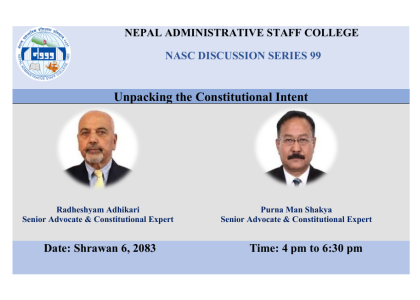
Unpacking Constitutional Intent (NASC Discussion Series 97)

View Details
View Details
Default Thumbnail Image
Sharpening the Saw
27 Jul, 2026

Sharpening the Saw (STS) 2080/81

View Details
View Details
View all Events
View all Events
Home
Nepal Administrative Staff College

An ISO 9001:2015 Certified Institution

The Nepal Administrative Staff College (NASC) is a national level autonomous institution established on 11 Aswin, 2039 BS. Learn More

Subscribe to Our Newsletter

Stay updated with the latest news and updates from NASC.

  • Services
    • Trainings
    • Research
    • Consulting
  • About Us
    • About NASC
    • Our Team/Staff
    • Department and Centers
    • Laws and policy
    • FAQs
  • Resources & Insights
    • Report and Publications
    • Updates
  • Quick links
    • Become a Trainer (Roster Update)
    • Join NASC (Vacancy)
    • Training Nomination Form
    • MoFAGA
    • Nepal Government Portal

Contact

Jawalakhel, Lalitpur, Nepal
info@nasc.org.np
  • +977-9851460800
  • +977-1-5422160
9851460800
https://www.facebook.com/nascnepal2
https://www.linkedin.com/company/nepal-administrative-staff-college-nasc
https://www.youtube.com/channel/UC8iOamPzewNp_5JcL8fnZBA

ISO certificate

ISO Certificate
© 2026 NASC, All rights reserved

Footer Bottom Menu

  • Privacy Policy
  • Terms of Service